Markets feel uncertain again.
You can see it in the headlines. You can feel it in client conversations.
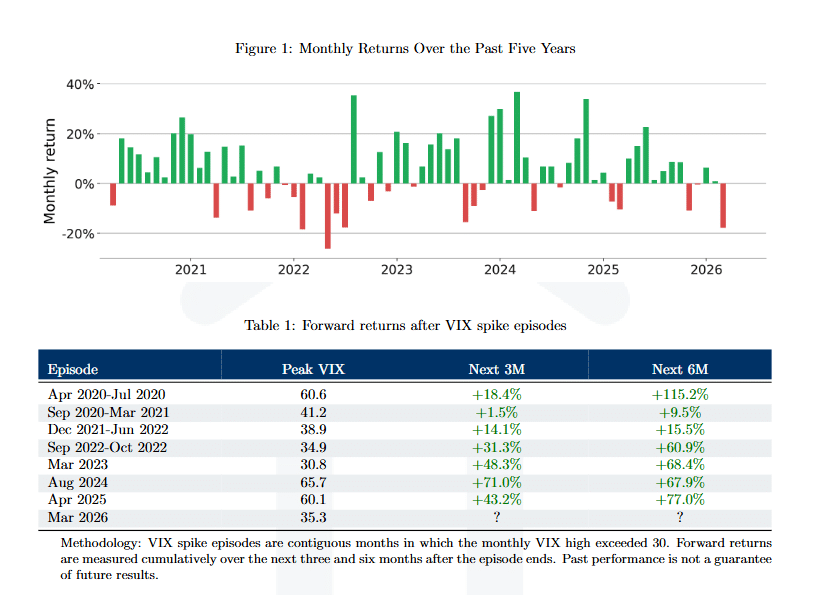
And you can definitely see it in charts like this — where returns jump from strong gains to sharp losses, month to month.
Volatility vs Risk — Stop Confusing the Two
Volatility is simply the range of outcomes.
Some months are up. Some are down.
The path is uneven.
But that’s very different from risk.
Risk is the chance of a permanent loss of capital.
Volatility is just the journey getting there.
This is where investors get themselves into trouble.
They experience short-term losses and assume something is broken when, in reality, it’s often just part of the process.
Volatility is what makes a portfolio feel uncomfortable.
It’s not what determines whether it succeeds.
What the VIX Actually Measures (And What It Doesn’t)
The VIX is called the “fear index”.
That’s a bit misleading.
All it really measures is the market’s expectation of volatility over the next 30 days.
In plain terms:
- Higher VIX = bigger expected moves
- Lower VIX = calmer conditions
What it doesn’t tell you is direction.
A high VIX doesn’t mean the market will fall.
It just means the market expects larger swings — up or down.
That distinction matters.
Because periods of high uncertainty often create pricing errors.
And pricing errors are where returns come from.
Why Volatility Feels So Uncomfortable
If volatility is normal, why does it feel so wrong?
Because of how we’re wired.
- We feel losses more than gains (loss aversion)
- We overweight recent events (recency bias)
- We anchor to “smooth” returns that don’t really exist
So when markets get noisy, investors shorten their time horizon.
They stop thinking in years…
and start reacting to weeks.
That’s where damage gets done.
What History Says About Volatility Spikes
Now here’s the part most people miss.
When volatility spikes — typically when the VIX moves above 30 — it’s usually during periods of stress.
That’s when markets feel the worst.
But if you look at what happens next, the pattern is surprisingly consistent.
Across multiple episodes:
- The following 3 months were positive
- The following 6 months were positive
- Average returns were materially higher than normal
In other words:
The moments that feel the worst have often been the best entry points.
Not because volatility disappears, but because mispricing gets corrected.
“Dislocations can create the raw materials for the next leg of returns.”
(Note: historical patterns should be treated cautiously and verified before use in advice.)
Why High-Performance Strategies Look Messy
There’s a trade-off most investors don’t fully appreciate.
If you want smoother returns, you can have them.
But you’ll usually give up upside.
If you want higher returns, the path won’t be smooth.
It will look like that chart.
That’s not a flaw.
That’s the cost of accessing opportunity.
Volatility isn’t a bug in the system; it’s the feature that allows excess returns to exist.
How to Invest When Markets Are Volatile
So what should you actually do when things feel uncertain?
Nothing dramatic.
But a few principles matter:
- Stay invested — timing mistakes are costly
- Rebalance rather than react
- Focus on your time horizon, not headlines
- Use volatility as an opportunity to deploy capital
Most importantly:
Make sure your strategy is built to handle volatility before it arrives.
Because in the moment, discipline is hard to manufacture.
The Real Risk Isn’t Volatility — It’s Behaviour
The biggest losses I see aren’t caused by markets.
They’re caused by decisions.
- Selling after a fall
- Waiting for certainty that never comes
- Abandoning a strategy at the worst possible time
Volatility doesn’t break portfolios.
Investor behaviour does.
Key Takeaways
- Volatility is normal — and necessary for higher returns
- The VIX measures uncertainty, not direction
- Market stress has historically created opportunity
- The biggest risk is reacting emotionally
- A good strategy should expect — and withstand — volatility
Final Thought
If your strategy only works when markets are calm…
it doesn’t really work.
The question isn’t how to avoid volatility.
It’s whether you’re prepared to live through it, so you can benefit from what tends to come next.
Disclaimer
This information is general in nature and doesn’t consider your objectives, financial situation or needs. Consider whether it’s appropriate for you. Past performance is not a reliable indicator of future results.